
Recently, Professor Sun Litao’s team at the School of Integrated Circuits, Southeast University, achieved a major breakthrough in the field of atomic scale manufacturing. By precisely controlling the interatomic spacing of single atoms, they successfully developed a novel sensor that improves the sensitivity of trace uric acid (UA) detection by nearly two orders of magnitude compared to conventional techniques. The related research findings were published in the international journal Angewandte Chemie International Edition under the title “Three-Electron Uric Acid Oxidation via Interdistance‑Dependent Switching Pathways in Correlated Single‑Atom Catalysts for Boosting Sensing Signals” and were selected as a Very Important Paper (VIP) and an Inside Back Cover paper.
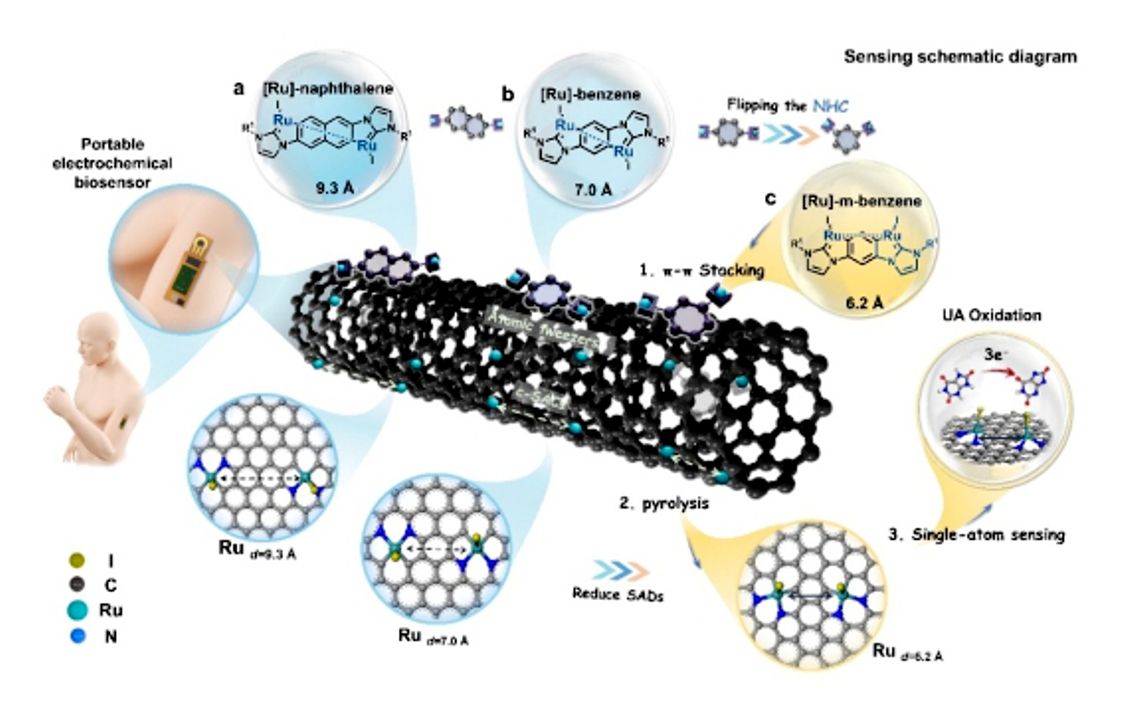
Early screening of metabolic diseases such as gout relies on precise detection of trace uric acid. However, conventional sensors suffer from low sensitivity and slow response, making them inadequate for rapid analysis. Single‑atom catalysts (SACs) have shown great promise in electrochemical sensing due to their nearly 100% atomic utilization and unique electronic structures. Nevertheless, traditional SACs exhibit randomly distributed catalytic atoms, leading to isolated active sites, low electron transfer efficiency, and sluggish catalytic reactions, which create bottlenecks of “inaccurate and slow” detection for trace uric acid.
To address this challenge, Professor Sun Litao’s team proposed an innovative strategy: using molecular tweezers to fix the distance between two catalytic ruthenium atoms. By precisely tuning the intradimeric Ru–Ru distance, they achieved synergistic catalysis between adjacent Ru atoms, resulting in a two‑order‑of‑magnitude enhancement in detection sensitivity. Experiments showed that when the interatomic distance was shortened to 6.2 Å, the dinuclear Ru single‑atom catalyst triggered a three‑electron oxidation pathway for uric acid (compared to the conventional two‑electron pathway), significantly lowering the reaction barrier and greatly enhancing the signal intensity, thus overcoming the technical hurdle of trace detection.
The team further integrated this technology into a flexible wearable sensor. By wearing the device, users can wirelessly synchronize real‑time uric acid levels in sweat to a mobile phone via Bluetooth, enabling dynamic metabolic status tracking. This technology can be extended to the accurate monitoring of various biomarkers such as glucose and lactate, promoting early warning of chronic diseases and the advancement of personalized medicine.
Doctoral student Bo Wen Jiang from Southeast University is the first author of the paper. Professors Kuibo Yin and Litao Sun from Southeast University are the corresponding authors, and Southeast University is the sole affiliated institution. This research was supported by the National Key Research and Development Program of China, the General Program of the National Natural Science Foundation of China, and the Postgraduate Research & Practice Innovation Program of Jiangsu Province.